
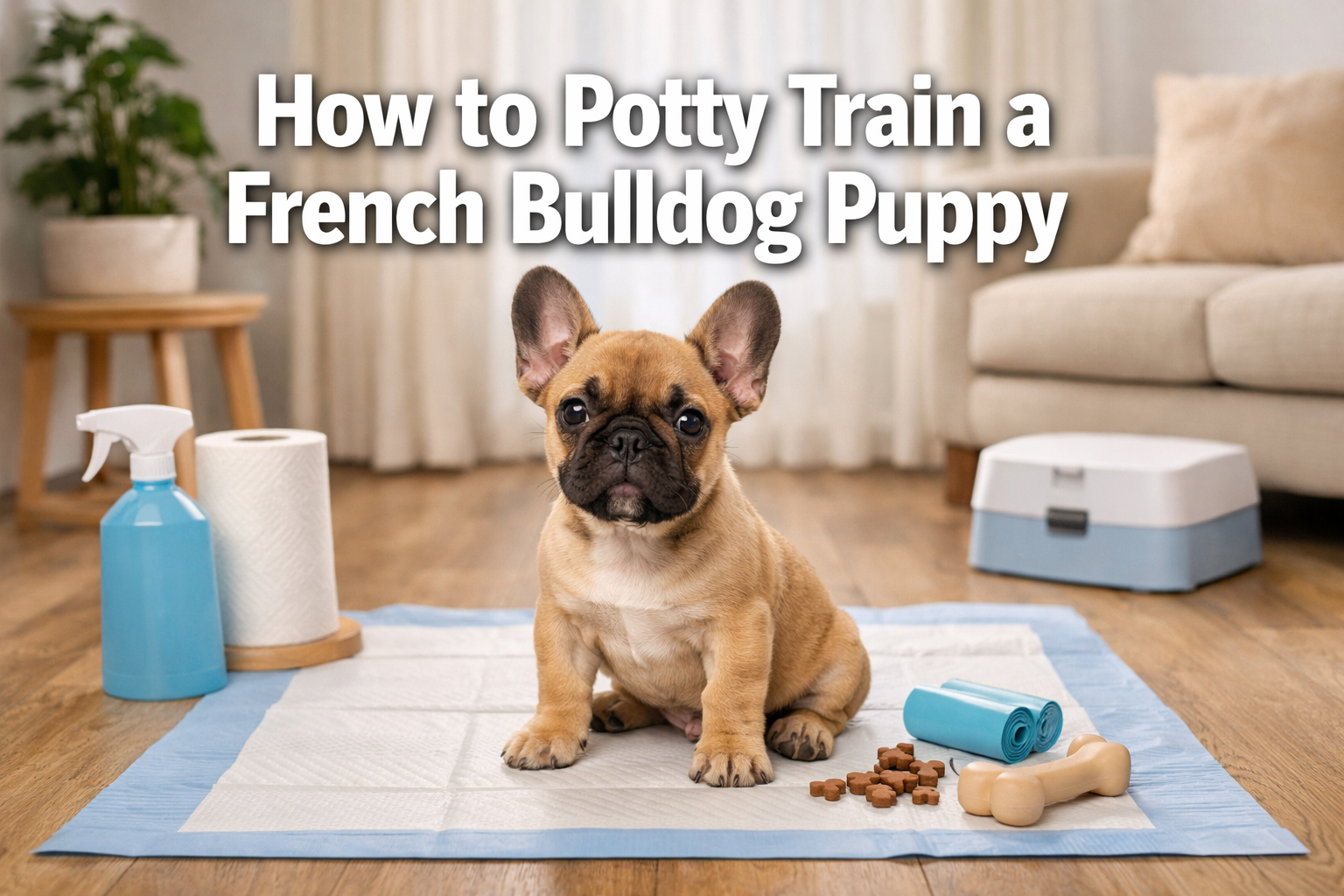
How to Potty Train a French Bulldog Puppy
Last updated: January 15, 2026
Picture this: you’ve just brought home your adorable French Bulldog puppy, and within hours, you discover little “surprises” scattered around your apartment. If you’re wondering how to potty train a French Bulldog puppy without losing your sanity, you’re not alone. French Bulldogs are intelligent, affectionate companions, but they can be surprisingly stubborn when it comes to housebreaking.
Key Takeaways
• Start early: Begin potty training between 8-12 weeks old for best results
• Consistency is crucial: Take your Frenchie puppy outside every 2 hours and immediately after meals, naps, and play
• Positive reinforcement works: Reward successful potty breaks with treats and praise rather than punishing accidents
• Expect 4-6 months: Most French Bulldog puppies are fully house-trained by 6 months, though some may take up to a year
• Use crate training: Dogs naturally avoid soiling their sleeping area, making crates effective for teaching bladder control
Quick Answer
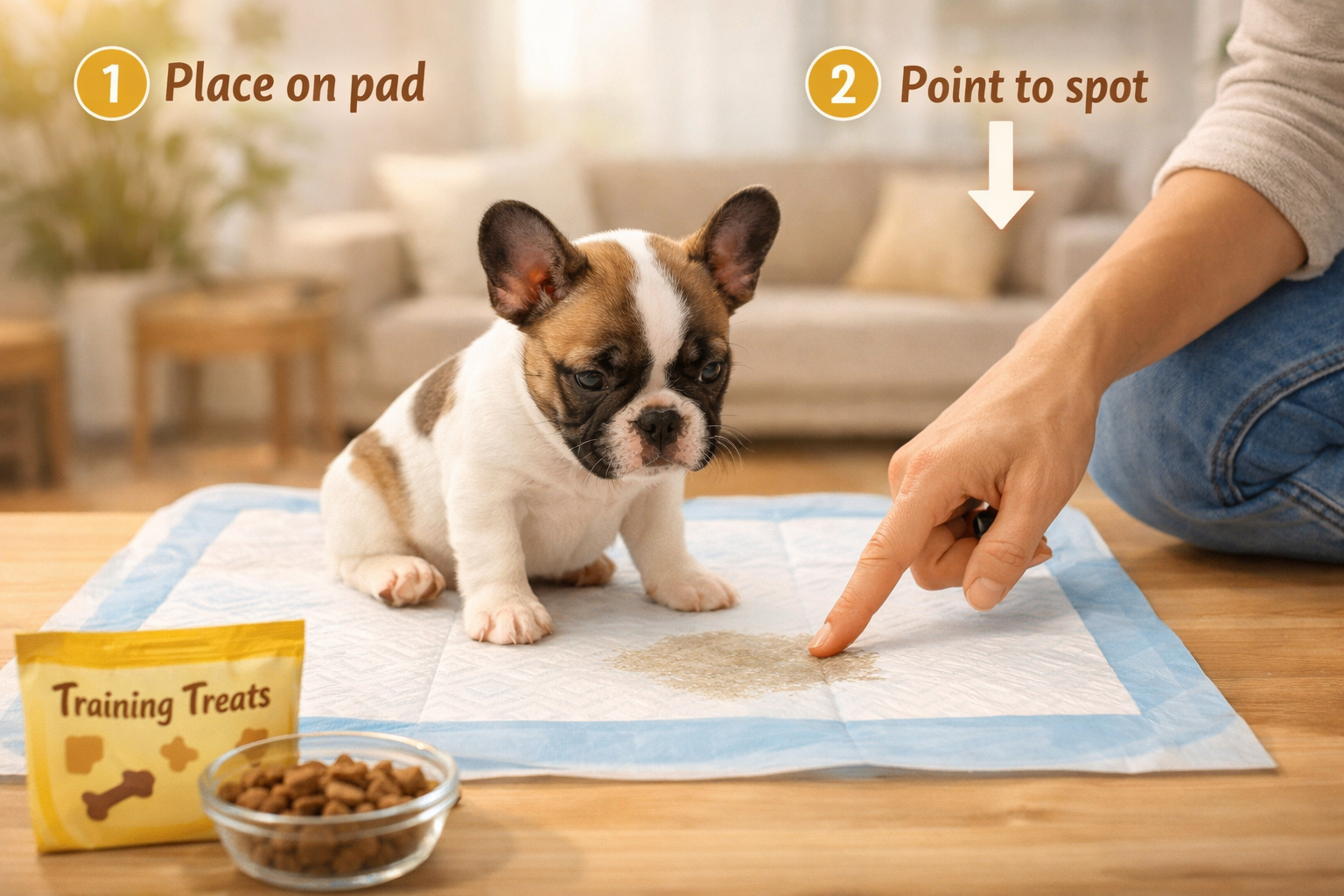
French Bulldog puppies can be successfully potty trained in 4-6 months using consistent scheduling, positive reinforcement, and patience. Take your puppy outside every 2 hours, immediately after meals and naps, and reward successful elimination with treats and praise. Start between 8-12 weeks old for optimal results, and remember that Frenchies’ independent nature requires extra consistency and short training sessions.
When Should You Start Potty Training Your French Bulldog Puppy?
The ideal time to begin potty training is between 8-12 weeks old, which is the critical learning window for puppies. At this age, French Bulldog puppies are developmentally ready to start understanding basic routines, though their bladder control is still limited.
Why timing matters:
- Puppies under 8 weeks have minimal bladder control
- The 8-12 week window is when puppies form lasting habits
- Starting too late can mean breaking established bad habits
- Early training takes advantage of natural learning behaviors
What to expect at different ages:
- 8-12 weeks: Can hold bladder for 1-2 hours maximum
- 3-4 months: Bladder control improves to 2-3 hours
- 4-6 months: Can typically hold it for 4-5 hours
- 6+ months: Most puppies can last 6-8 hours overnight
Choose to start immediately when you bring your puppy home, regardless of age. Even if your Frenchie is older than 12 weeks, consistent training will still work—it may just take a bit longer to override existing habits.
How Often Should French Bulldog Puppies Go Outside?
French Bulldog puppies need frequent potty breaks due to their small bladders and fast metabolisms. Puppies under 12 weeks need to go outside every 2 hours during the day.
Essential potty break schedule:
- Every 2 hours during waking hours for puppies under 12 weeks
- Every 30-60 minutes when actively playing or excited
- Immediately after waking up from naps
- Within 15-30 minutes after eating or drinking
- Right before bedtime
- Once during the night for very young puppies (under 16 weeks)
Age-based frequency guide:
- 8-12 weeks: Every 1-2 hours
- 3-4 months: Every 2-3 hours
- 4-6 months: Every 3-4 hours
- 6+ months: Every 4-6 hours
The key mistake many owners make is waiting for their puppy to signal they need to go out. Young French Bulldogs often don’t give clear warning signs, so proactive scheduling prevents accidents better than reactive responses.
For comprehensive guidance on caring for your French Bulldog puppy, including feeding schedules that support potty training, check our complete care guide.
What’s the Best Step-by-Step Method to Potty Train a French Bulldog Puppy?
The most effective approach combines consistent scheduling with positive reinforcement and designated potty areas. This method works because it builds predictable routines that French Bulldogs can easily follow.
Step 1: Establish a designated potty spot
- Choose one specific area outside (or indoor potty pad location)
- Always take your puppy to the same spot
- Use a consistent route to get there
- Keep the area clean and accessible
Step 2: Create a verbal cue
- Pick a simple command like “Go potty” or “Do your business”
- Say the command every time you reach the potty spot
- Use the same words consistently—don’t vary the phrase
- Say it in a calm, encouraging tone
Step 3: Follow the timing schedule
- Set phone alarms for every 2 hours initially
- Take puppy out immediately after meals, naps, and play
- Don’t wait for signs—be proactive
- Stay outside until they eliminate (up to 10 minutes)
Step 4: Reward immediately
- Give treats and enthusiastic praise the moment they finish
- Make the reward exciting—this is a big deal!
- Return inside promptly after successful elimination
- Don’t extend outdoor time as a reward (this can confuse the purpose)
Step 5: Handle accidents properly
- Clean accidents immediately with enzymatic cleaner
- Never punish or scold—just clean and move on
- Increase supervision and frequency of breaks
- Look for patterns in when accidents happen
FYI: Some links may be affiliate links, which means I may earn a small commission at no extra cost to you.
If you want something structured to help with overall training consistency, this gentle training approach can be helpful for building better communication and focus with your Frenchie during potty training sessions.
How Long Does It Take to Fully Potty Train a French Bulldog Puppy?
Most French Bulldog puppies achieve reliable house training in 4-6 months, though some may take up to a year depending on consistency and individual temperament. The timeline varies significantly based on several factors.
Typical training milestones:
- Weeks 1-4: Learning the routine, frequent accidents normal
- Months 2-3: Fewer accidents, starting to signal or hold it longer
- Months 4-6: Reliable during the day, occasional nighttime accidents
- 6+ months: Fully house-trained with rare accidents
Factors that speed up training:
- Starting between 8-12 weeks old
- Consistent daily schedule maintained by all family members
- Immediate rewards for successful elimination
- Proper crate training to develop bladder control
- Regular feeding schedule (helps predict elimination timing)
What slows down the process:
- Inconsistent schedules or mixed signals from family members
- Punishment for accidents (creates fear and confusion)
- Free-feeding (makes elimination timing unpredictable)
- Medical issues like urinary tract infections
- French Bulldog stubbornness—they need extra patience and consistency
Remember that “fully trained” means your puppy can hold it for age-appropriate periods and signals when they need to go out. Even well-trained dogs may have occasional accidents during illness, stress, or major routine changes.
Should You Use Crate Training for Potty Training French Bulldog Puppies?
Crate training is highly effective for potty training because dogs naturally avoid soiling their sleeping area. This instinct helps French Bulldog puppies develop better bladder control and creates a safe space for times when you can’t supervise.
How crate training supports potty training:
- Teaches puppies to “hold it” for gradually longer periods
- Prevents accidents when you’re not watching
- Creates a predictable routine (crate time = hold it, outside time = go potty)
- Reduces anxiety by providing a secure den-like space
Proper crate training steps:
- Size the crate correctly: Large enough to stand and turn around, not large enough to eliminate in one corner
- Start with short periods: 30-60 minutes initially, gradually increasing
- Always take puppy straight outside after crate time
- Never use the crate as punishment—it should be a positive space
- Provide comfortable bedding and a favorite toy
Crate schedule for potty training:
- Nighttime: 6-8 hours for puppies over 16 weeks
- During work: Maximum 4 hours for puppies under 6 months
- After meals: 1-2 hours to prevent accidents while food digests
- When unsupervised: Any time you can’t watch for elimination signals
The common mistake is using a crate that’s too large. If your Frenchie can eliminate in one corner and sleep in another, the crate won’t teach bladder control effectively.
For detailed guidance on crate training your French Bulldog, including sizing and comfort tips, our comprehensive guide covers everything you need to know.
What Are the Most Effective Rewards for French Bulldog Puppy Potty Training?
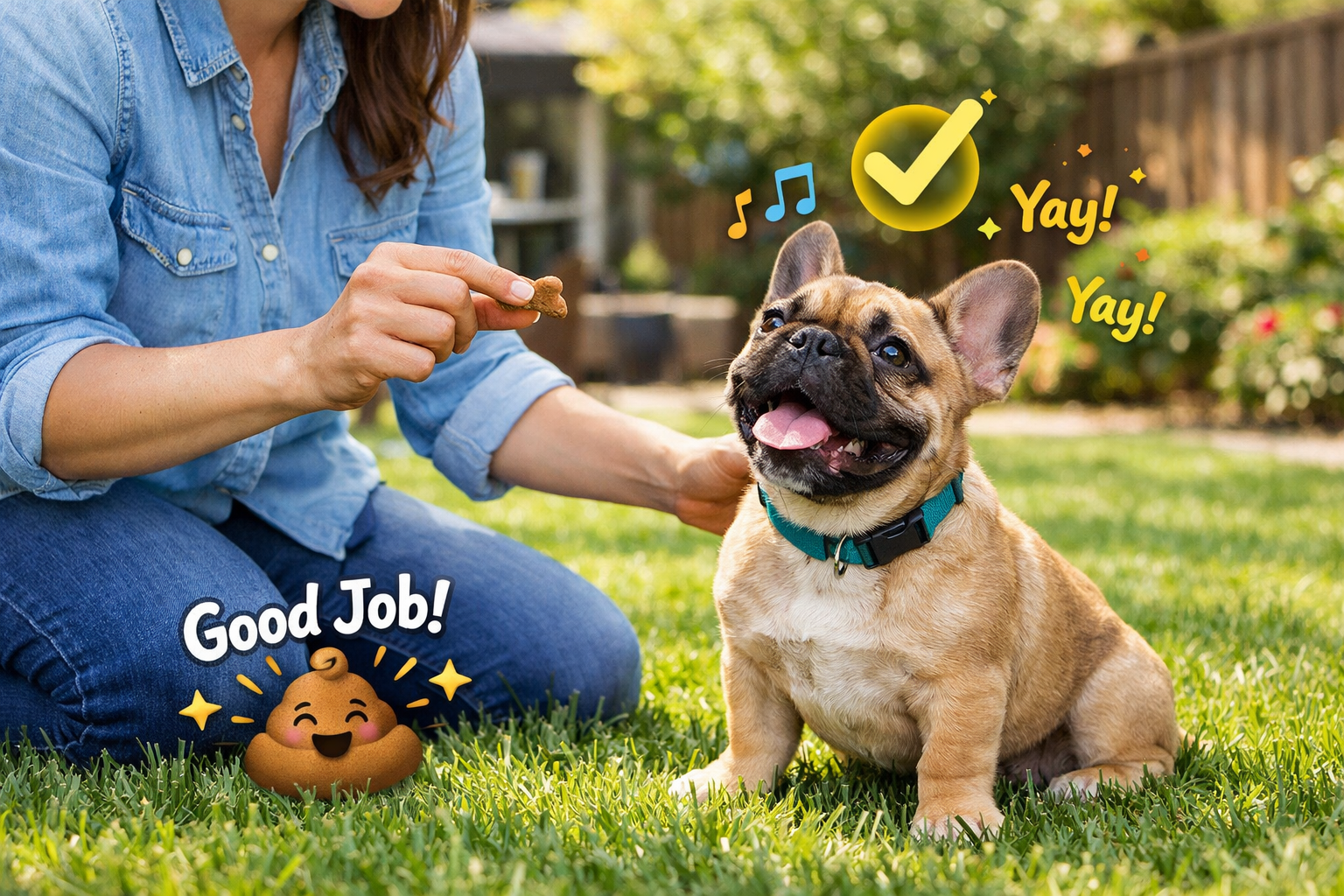
French Bulldogs respond exceptionally well to food rewards combined with enthusiastic praise, making positive reinforcement the most successful training approach. The key is timing and consistency—rewards must happen immediately after successful elimination.
Best reward types for French Bulldogs:
- High-value treats: Small, soft treats they can eat quickly (pea-sized portions)
- Enthusiastic verbal praise: “Good potty!” in an excited, happy voice
- Physical affection: Gentle pets and scratches (if your puppy enjoys touch)
- Brief play session: 30 seconds of exciting interaction before going inside
Timing is everything:
- Reward the moment they finish eliminating, not when you get back inside
- Keep treats in your pocket or by the door for immediate access
- Don’t delay rewards to clean up or put on shoes
- Make the reward exciting enough that your puppy looks forward to potty time
What treats work best:
- Soft training treats that don’t require chewing
- Freeze-dried liver or chicken (high motivation)
- Small pieces of cooked chicken or cheese
- Commercial puppy training treats (avoid large or hard treats)
Avoid these reward mistakes:
- Delayed rewards: Waiting until you’re back inside reduces effectiveness
- Inconsistent rewards: Sometimes rewarding, sometimes forgetting
- Over-rewarding: Too many treats can cause stomach upset
- Wrong timing: Rewarding the walk back inside instead of the elimination
For the best training treats specifically for French Bulldogs, including size and ingredient recommendations, check our detailed treat guide.
How Do You Handle Accidents During French Bulldog Puppy Potty Training?
Accidents are completely normal and expected during potty training—how you handle them determines whether they become learning opportunities or setbacks. Never punish accidents, as this creates fear and can actually slow down the training process.
Immediate response to accidents:
- Stay calm: Don’t react with anger or frustration
- Clean thoroughly: Use enzymatic cleaner to eliminate odor completely
- Increase supervision: Watch more closely for elimination signals
- Review your schedule: Accidents often mean more frequent breaks are needed
Proper cleaning technique:
- Blot, don’t rub: Absorb as much liquid as possible first
- Use enzymatic cleaner: Regular cleaners won’t eliminate the scent that draws dogs back
- Clean beyond the visible area: Urine often spreads under the surface
- Let cleaner work: Follow product instructions for contact time
- Avoid ammonia-based cleaners: These smell like urine to dogs
What accidents tell you:
- Frequent accidents: Schedule needs more potty breaks
- Same location accidents: Area wasn’t cleaned thoroughly enough
- Accidents near the door: Puppy is trying to signal but needs help getting outside faster
- Nighttime accidents: Crate may be too large, or puppy needs a middle-of-night break
Never do these things:
- Rub their nose in the accident
- Yell or punish after the fact (dogs don’t understand delayed consequences)
- Use the accident as a “teaching moment”—just clean and move on
- Restrict water access (this can cause health problems)
If accidents increase suddenly after improvement, check for medical issues like urinary tract infections or digestive problems that might be affecting your puppy’s control.
What Common Mistakes Should You Avoid When Potty Training French Bulldog Puppies?
French Bulldog owners often make specific mistakes that can significantly delay potty training progress. Understanding these pitfalls helps you avoid weeks or months of frustration.
Mistake #1: Inconsistent scheduling
- Problem: Different family members follow different schedules
- Solution: Post a written schedule everyone follows, set phone alarms
- Why it matters: Inconsistency confuses puppies and slows habit formation
Mistake #2: Waiting for signals
- Problem: Expecting young puppies to clearly communicate their needs
- Solution: Be proactive with scheduled breaks rather than reactive
- Why it matters: Young French Bulldogs often don’t give obvious warning signs
Mistake #3: Using punishment for accidents
- Problem: Scolding or punishing accidents creates fear and anxiety
- Solution: Focus entirely on rewarding success, ignore failures
- Why it matters: Punishment can make puppies afraid to eliminate in front of you, even outside
Mistake #4: Inadequate cleaning
- Problem: Using regular cleaners that don’t eliminate scent markers
- Solution: Always use enzymatic cleaners designed for pet accidents
- Why it matters: Lingering scents draw dogs back to the same spots
Mistake #5: Giving up too quickly
- Problem: Expecting faster results than the 4-6 month timeline
- Solution: Remember that French Bulldogs can be stubborn and need extra patience
- Why it matters: Consistency over months, not weeks, creates lasting habits
Mistake #6: Wrong crate size
- Problem: Crate too large allows elimination in one corner
- Solution: Use dividers or smaller crate until puppy grows
- Why it matters: Defeats the natural instinct to keep sleeping area clean
The biggest mistake is underestimating how much consistency French Bulldogs need. Their independent personality means they require more repetition and patience than some other breeds.
Helpful Resources for French Bulldog Puppy Training Success
If you want something structured to support your potty training efforts, there are several resources that can make the process smoother and more effective for both you and your Frenchie.
For comprehensive training support: If you’re looking for a gentle, step-by-step approach that covers potty training alongside other essential puppy behaviors, this structured training method can be helpful for building better communication and consistency with your French Bulldog puppy.
For health support during training: Potty training can sometimes be affected by digestive issues or stress. This natural probiotic formula is designed to support your dog’s gut health and digestion, which can help maintain regular elimination patterns during the training process.
For long-term health protection: French Bulldogs are prone to specific health issues that can affect house training success. Comparing pet insurance options early can help you address any medical concerns that might interfere with potty training progress.
These resources aren’t required for successful potty training, but they can provide additional structure and support if you want a more comprehensive approach to raising a well-behaved, healthy French Bulldog.
Frequently Asked Questions
How long can a French Bulldog puppy hold their bladder?
Puppies can typically hold their bladder for about one hour per month of age, plus one hour. So a 3-month-old puppy can hold it for approximately 4 hours maximum, though 2-3 hours is more realistic for active periods.
Should I wake my French Bulldog puppy up at night to go potty?
For puppies under 16 weeks, one middle-of-night potty break is usually necessary. Set an alarm for 4-5 hours after bedtime, take them out quickly and quietly, then return to the crate immediately.
Can I use puppy pads for French Bulldog potty training?
Puppy pads can work for apartment living but may confuse some puppies about where elimination is acceptable. If using pads, place them in one consistent location and gradually move them closer to the door, then outside.
What if my French Bulldog puppy won’t go potty outside?
Stay patient and wait up to 10 minutes outside. If they don’t eliminate, bring them in and try again in 15-20 minutes. Some puppies need time to adjust to outdoor elimination, especially if they started with indoor pads.
How do I know if my French Bulldog puppy has a medical issue affecting potty training?
Signs include sudden increases in accidents after progress, straining to urinate, blood in urine, excessive drinking, or diarrhea lasting more than 24 hours. Consult your veterinarian if you notice these symptoms.
Should I restrict water during potty training?
Never restrict water access as this can cause health problems. Instead, monitor when your puppy drinks large amounts and plan potty breaks accordingly—usually 15-30 minutes after drinking.
Can older French Bulldog puppies (6+ months) still be potty trained?
Absolutely. While it may take longer to break established habits, the same consistent schedule and positive reinforcement methods work for older puppies. Some may actually learn faster due to better bladder control.
What’s the best time of day to start intensive potty training?
Start on a weekend or when you have 3-4 consecutive days at home to establish the routine. Consistency in the first few days sets the foundation for long-term success.
How do I potty train a French Bulldog puppy in an apartment?
Use the same principles but consider indoor alternatives like balcony potty areas or frequent elevator trips outside. Consistency with location and timing matters more than whether it’s a yard or designated outdoor spot.
Should both indoor and outdoor potty options be available?
Choose one primary method to avoid confusion. If you must use both (like pads for emergencies), make clear distinctions about when each is appropriate and maintain the same reward system for both.
What if my French Bulldog puppy seems to understand but still has accidents?
This is normal during the learning process. Ensure you’re providing frequent enough breaks, cleaning accidents thoroughly, and maintaining consistent rewards. Most puppies have occasional accidents until 6+ months old.
How do feeding schedules affect French Bulldog potty training?
Regular feeding times create predictable elimination schedules. Most puppies need to eliminate within 15-30 minutes after eating. Consistent feeding schedules support successful potty training timing.
Conclusion
Successfully potty training your French Bulldog puppy requires patience, consistency, and understanding of their unique personality traits. While Frenchies can be wonderfully stubborn, they’re also intelligent and eager to please their families. The 4-6 month timeline isn’t just about teaching your puppy where to eliminate—it’s about building a foundation of trust and communication that will benefit your relationship for years to come.
Your next steps:
- Start immediately with a consistent schedule of potty breaks every 2 hours
- Choose your rewards and keep them easily accessible for immediate reinforcement
- Set up your space with proper cleaning supplies and a correctly-sized crate
- Track progress by noting successful eliminations and accident patterns
- Stay patient through the inevitable setbacks and celebrate small victories
Remember that every accident is a learning opportunity, not a failure. Your French Bulldog puppy wants to make you happy—they just need clear, consistent guidance to understand what that means. With the right approach, you’ll soon have a reliably house-trained companion who brings joy to your daily routine rather than stress about finding surprises around your home.
The investment in proper potty training pays dividends in the form of a confident, well-adjusted French Bulldog who understands their place in your family. Start today, stay consistent, and trust the process—your future self will thank you for the effort you put in now.
References
[1] How To Potty Train A French Bulldog A Step By Step Guide – https://happytailpuppies.com/blogs/news/how-to-potty-train-a-french-bulldog-a-step-by-step-guide
[2] How To Potty Train Your French Bulldog Puppy Tips Tricks – https://waggstoriches.com/how-to-potty-train-your-french-bulldog-puppy-tips-tricks/
[3] Watch – https://www.youtube.com/watch?v=KOSlKwpW-Qk