
Positive Reinforcement Training for French Bulldogs: The Complete Guide to a Well-Behaved Frenchie
Picture this: you’re sitting in your cozy apartment after a long day at work, and your French Bulldog greets you with perfect manners instead of jumping all over you. No pulling on walks, no excessive barking at neighbors, and definitely no chewed-up shoes. This isn’t just a dream—it’s absolutely achievable through positive reinforcement training for French Bulldogs. As someone who’s worked with countless Frenchie families over the years, I can confidently say that this gentle, science-backed approach transforms not just your dog’s behavior, but your entire relationship together.
French Bulldogs are naturally people-pleasing companions who thrive on affection and approval, making them ideal candidates for reward-based training methods. Unlike harsh correction techniques that can damage their sensitive spirits, positive reinforcement builds confidence while teaching the behaviors you actually want to see. Whether you’re a first-time dog owner in a studio apartment or a busy professional seeking a well-mannered companion, this comprehensive guide will show you exactly how to train your Frenchie using methods that work with their unique personality, not against it.
Key Takeaways
• French Bulldogs respond exceptionally well to positive reinforcement because of their people-focused nature and emotional sensitivity to harsh corrections
• Keep training sessions short (5-10 minutes) and frequent throughout the day to match your Frenchie’s attention span and learning style
• Consistency in commands and timing is crucial for success—use the same cues every time and reward immediately when your dog performs the desired behavior
• Start early with puppy socialization using positive experiences to build confidence and prevent behavioral issues later in life
• Exercise before training sessions helps French Bulldogs focus better and makes learning more effective
Understanding Positive Reinforcement Training for French Bulldogs
What Makes French Bulldogs Unique Training Candidates
French Bulldogs possess a distinctive combination of traits that make them both delightful and challenging to train. Their strong desire to please their humans stems from centuries of selective breeding for companionship, but this same trait makes them incredibly sensitive to their owner’s emotions and reactions. When you raise your voice or show frustration, your Frenchie doesn’t just hear it—they feel it deeply, often becoming withdrawn or anxious.
This emotional sensitivity is precisely why positive reinforcement training for French Bulldogs works so effectively. Rather than shutting down when corrected, Frenchies light up when they receive praise, treats, or affection for good behavior. I’ve watched countless French Bulldogs transform from stubborn, seemingly untrainable pups into eager-to-please companions simply by switching from punishment-based methods to reward-based approaches.
The Science Behind Positive Reinforcement
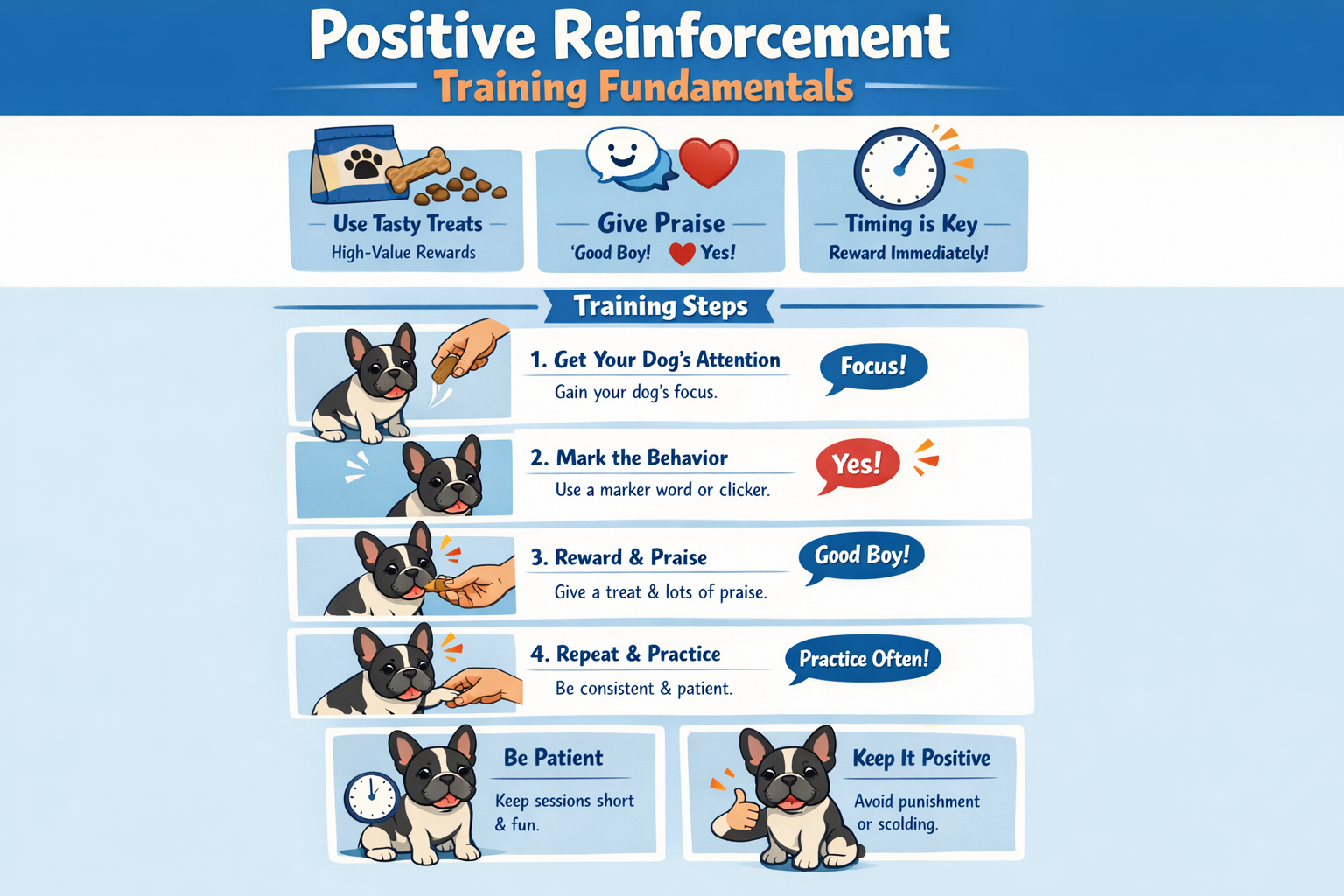
Positive reinforcement operates on a simple but powerful principle: behaviors that are rewarded are more likely to be repeated. When your French Bulldog sits and immediately receives a high-value treat plus enthusiastic praise, their brain creates a positive association with the “sit” command. Over time, this association becomes so strong that your Frenchie will offer the behavior automatically, hoping to earn that wonderful reward.
The timing of rewards is absolutely critical. You have approximately 3-5 seconds after your dog performs the desired behavior to deliver the reward. Any longer, and your Frenchie may not connect the reward with the specific action you wanted to reinforce. This is why many successful trainers use clicker training—the distinct sound marks the exact moment your dog did something right, even if you need a few extra seconds to deliver the treat.
Why Punishment-Based Methods Fail with French Bulldogs
Traditional “alpha” or dominance-based training methods can be particularly damaging for French Bulldogs. These sensitive souls don’t respond well to intimidation, loud corrections, or physical punishment. Instead of learning what you want them to do, they often become fearful, anxious, or completely shut down during training sessions.
I’ve worked with many rescue Frenchies who came from homes where harsh correction methods were used. These dogs often exhibit:
- Extreme anxiety around training or when they make mistakes
- Reluctance to try new behaviors for fear of being wrong
- Decreased bonding with their owners due to fear-based associations
- Increased stubbornness as a self-protection mechanism
The beautiful thing about switching to positive reinforcement is how quickly these dogs bloom once they realize training is actually fun and rewarding.
Essential Foundations for Successful Positive Reinforcement Training
Setting Up Your Training Environment
Creating the right environment for positive reinforcement training for French Bulldogs sets you up for success from day one. Start in a quiet, familiar space with minimal distractions—your living room or a calm area of your apartment works perfectly. French Bulldogs can be easily distracted by interesting smells, sounds, or sights, so beginning in a controlled environment helps them focus on learning.
Remove potential distractions before starting each session:
- Put away toys (unless they’re part of the training)
- Turn off the television
- Ask family members to avoid the training area
- Ensure your Frenchie has had a bathroom break
- Have your treats and training tools ready
As your Frenchie masters behaviors in this controlled setting, you’ll gradually add distractions and practice in new locations. This process, called generalization, helps ensure your dog responds to commands whether you’re at home, in the park, or visiting friends.
Choosing the Right Rewards
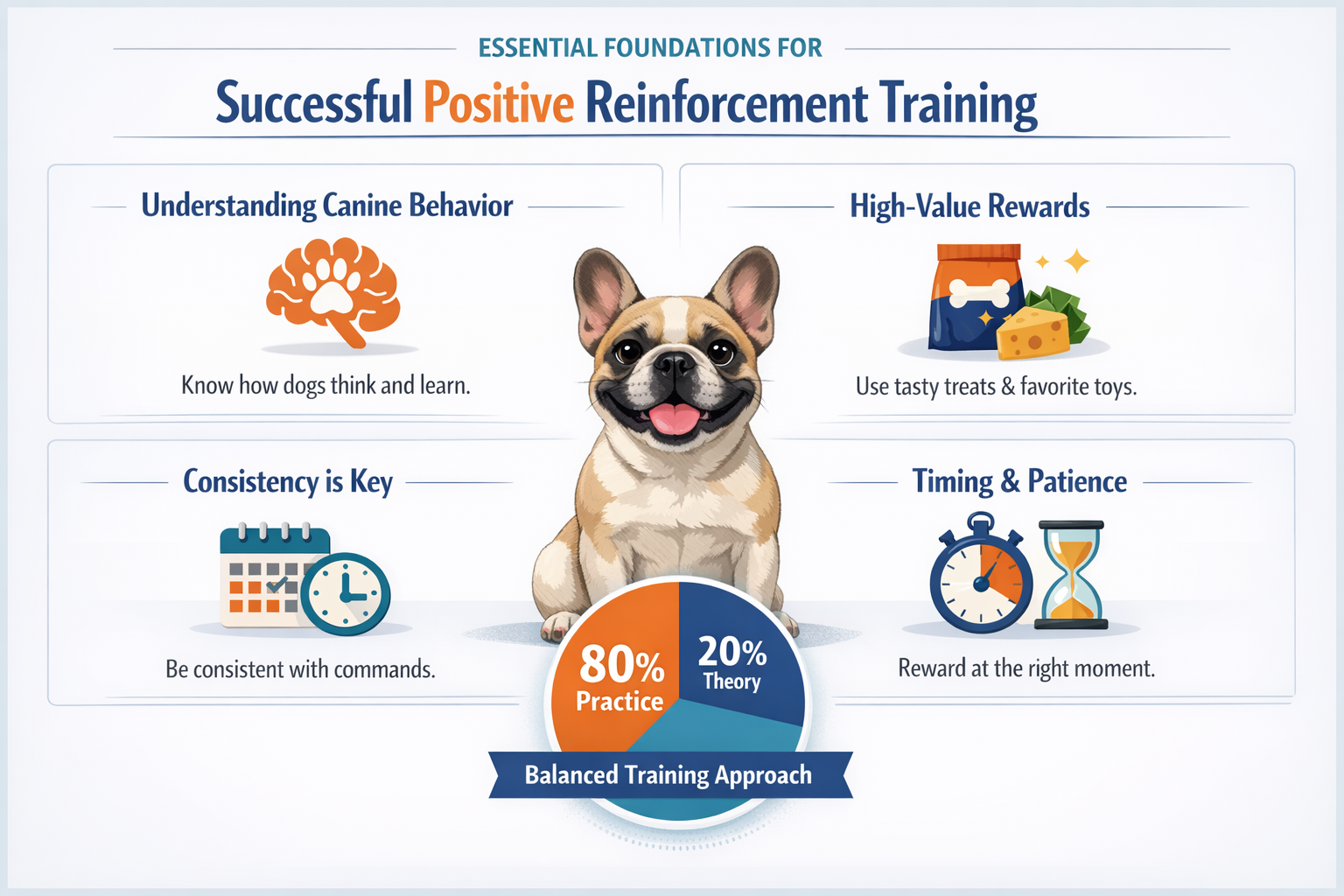
Not all rewards are created equal in your French Bulldog’s mind. High-value treats should be small, soft, and absolutely irresistible to your Frenchie. Think tiny pieces of cooked chicken, freeze-dried liver, or commercial training treats that can be consumed quickly without interrupting the training flow.
Effective reward hierarchy for most French Bulldogs:
- Ultra-high value: Fresh cooked chicken, cheese, or liver treats (for challenging behaviors)
- High value: Commercial training treats, small pieces of hot dog
- Medium value: Regular dog treats, kibble
- Praise and affection: Enthusiastic “good dog!” with petting
- Life rewards: Access to toys, going outside, or playtime
Remember that food isn’t the only motivator. Many French Bulldogs are equally motivated by praise, petting, or brief play sessions. Pay attention to what makes your individual Frenchie’s tail wag most enthusiastically—that’s your golden ticket to training success.
Timing and Consistency: The Twin Pillars of Success
Consistency in commands is absolutely critical for French Bulldog training success. If you use “sit” one day, “sit down” the next, and “park it” the third day, you’re essentially teaching three different commands instead of reinforcing one solid behavior. Choose your cue words carefully and ensure every family member uses the exact same commands.
Timing your rewards perfectly takes practice but makes an enormous difference in training speed. The moment your Frenchie’s bottom touches the ground during a “sit” command, that’s when the reward should be delivered—not when they’re already standing back up or looking around the room.
Here’s a helpful timing exercise I recommend to new Frenchie owners:
- Practice saying “Yes!” or clicking your clicker the instant you see the desired behavior
- Follow immediately with the treat delivery
- Keep treats in a easily accessible pouch or bowl nearby
- Practice this sequence until it becomes automatic
The Power of Short, Frequent Sessions
French Bulldogs have relatively short attention spans, especially as puppies, making 5-10 minute training sessions far more effective than longer, marathon training periods. I always tell my clients: “Better to train for 5 minutes three times a day than 15 minutes once a day.”
Optimal training schedule for French Bulldogs:
- Morning session (5-10 minutes): Basic commands before breakfast
- Afternoon session (5-10 minutes): Practice during a natural energy lull
- Evening session (5-10 minutes): Review and reinforce before dinner
This approach works particularly well for busy professionals and apartment dwellers because it fits easily into daily routines. Your Frenchie stays engaged and eager for each short session, rather than becoming bored or overwhelmed during longer training periods.
If you’re looking for a more structured approach to training, especially if your Frenchie tends to be reactive on walks or struggles with focus, this gentle, force-free training method has helped many French Bulldog owners create calmer, more enjoyable daily walks using positive reinforcement techniques.
FYI: Some links may be affiliate links, which means I may earn a small commission at no extra cost to you.
Step-by-Step Positive Reinforcement Training Techniques
Teaching Basic Commands Through Positive Reinforcement
Starting with “Sit”—The Foundation Command
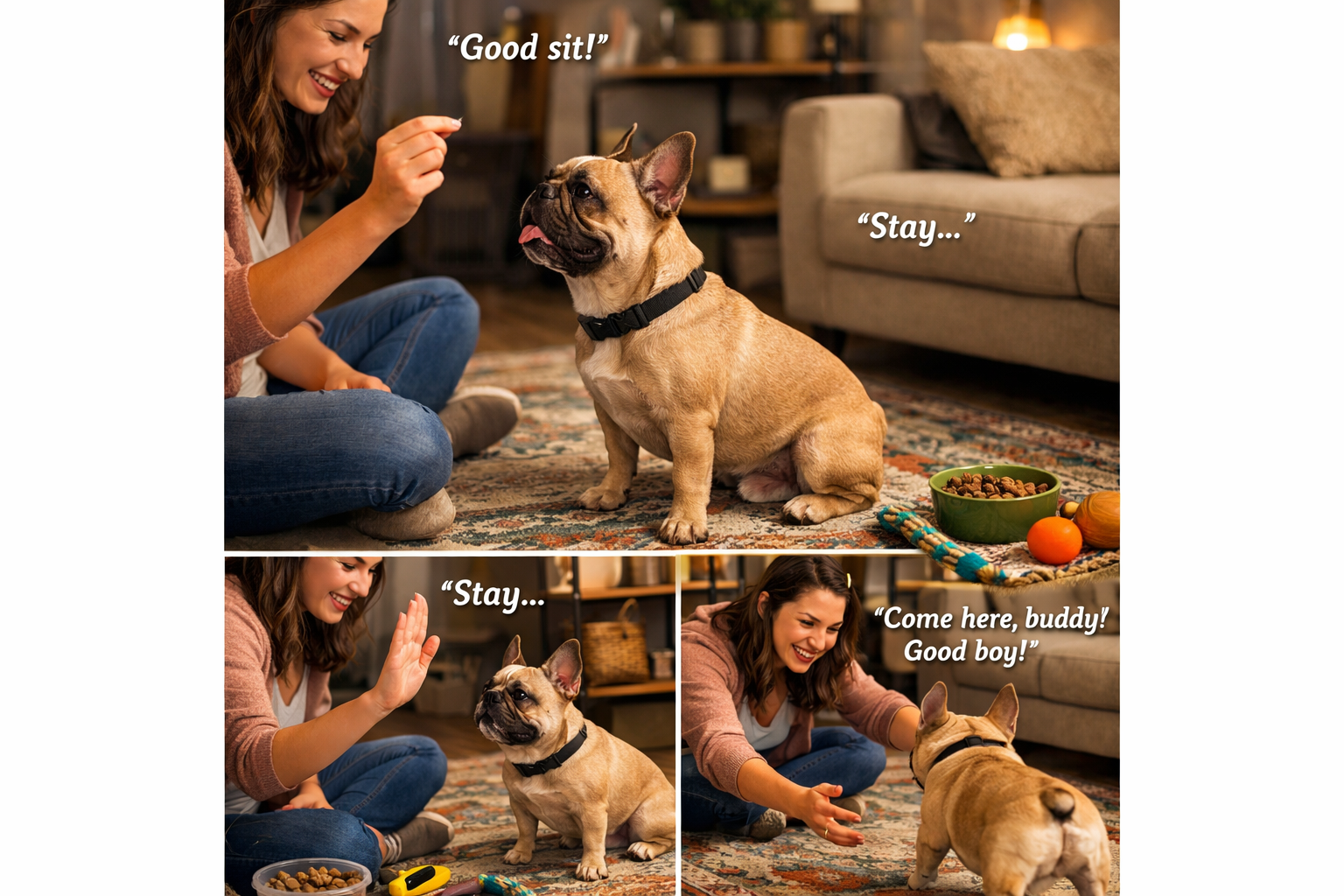
The “sit” command serves as the cornerstone for all other training because it’s relatively easy for French Bulldogs to understand and perform. Begin with your Frenchie standing in front of you, holding a high-value treat close to their nose. Slowly lift the treat over their head toward their back—as their head follows the treat upward, their bottom naturally lowers to the ground.
The moment their rear end touches the floor, immediately say “Yes!” or click your clicker, then give the treat and praise enthusiastically. Repeat this sequence 5-7 times per training session, always ending on a successful repetition to keep your Frenchie motivated for the next session.
Common mistakes to avoid:
- Don’t push your dog’s bottom down—let them choose to sit
- Avoid repeating “sit, sit, sit” if they don’t respond immediately
- Never hold the treat too high, causing jumping instead of sitting
- Don’t forget to release them from the sit with a clear “okay” or “free” command
Building “Stay” for Impulse Control
Once your French Bulldog reliably sits on command, you can begin teaching “stay”—a crucial skill for safety and good manners. Start with your Frenchie in the sit position, then hold your hand up in a “stop” gesture while taking one small step backward.
If they remain sitting for even 2-3 seconds, immediately return to them (don’t call them to you), give the treat, and praise. Gradually increase the duration and distance over multiple training sessions, but always return to your dog to release them rather than calling them to break the stay.
Progressive stay training schedule:
- Week 1: 3-5 seconds, 1 step away
- Week 2: 10-15 seconds, 2-3 steps away
- Week 3: 30 seconds, across the room
- Week 4: 1-2 minutes, out of sight briefly
Mastering “Come” for Safety and Freedom
A reliable recall command can literally save your French Bulldog’s life, making it one of the most important behaviors to teach through positive reinforcement. Never call your dog to come for something they perceive as negative—this includes ending playtime, giving baths, or leaving the dog park.
Start recall training indoors with minimal distractions. Get down to your Frenchie’s level, say “come” in a happy, excited voice, and gently pat your legs or clap your hands. When they move toward you, praise enthusiastically throughout their approach, then reward with treats and affection when they reach you.
Advanced recall training tips:
- Practice during meal times when motivation is naturally high
- Use different family members to call your Frenchie back and forth
- Gradually add distractions like toys or other people
- Always make coming to you the best thing that happens to your dog
For more comprehensive guidance on basic training foundations, check out our detailed French Bulldog training tips for beginners guide.
Addressing Common Behavioral Challenges
Stopping Jumping Through Positive Redirection
French Bulldogs are naturally social and often jump on people to get closer to faces and seek attention. Rather than pushing them down or saying “no,” teach an incompatible behavior like “sit for greetings” [4]. When someone approaches your Frenchie, immediately cue “sit” and reward them for keeping four paws on the ground.
Training protocol for polite greetings:
- Have a helper approach your Frenchie
- The moment your dog starts to jump, the person turns away and ignores them
- When your dog’s feet return to the ground, immediately cue “sit”
- Reward the sit with treats and allow calm petting
- If jumping resumes, repeat the process
Managing Excessive Barking Positively
French Bulldogs can be quite vocal, especially in apartments where they hear neighbors and street sounds regularly. Teaching a “quiet” command through positive reinforcement works much better than yelling or using bark collars.
When your Frenchie barks, wait for a natural pause (even just 2-3 seconds), then immediately say “quiet” and reward the silence. Gradually increase the duration of quiet time before giving the reward. This teaches your dog that silence, not barking, earns good things.
Preventing Resource Guarding Before It Starts
Resource guarding—when dogs become possessive over food, toys, or spaces—can be prevented through positive association training. Teach your Frenchie that human hands near their valuable items predict wonderful things.
While your dog eats, occasionally drop an extra special treat into their bowl. When they’re playing with a toy, approach and offer a high-value treat, then give the toy back immediately. This creates positive associations with human presence around their resources rather than fear or defensiveness.
Socialization Through Positive Experiences
Early Puppy Socialization Windows
The critical socialization period for puppies occurs between 3-14 weeks of age, making positive reinforcement during early experiences absolutely crucial. Every new person, animal, sound, or environment your French Bulldog puppy encounters should be paired with something wonderful—treats, praise, or play.
Essential socialization experiences for French Bulldog puppies:
- Different types of people (children, elderly, people wearing hats/uniforms)
- Various surfaces (grass, concrete, metal grates, stairs)
- Household sounds (vacuum cleaner, doorbell, television)
- Car rides and different environments
- Other well-socialized dogs and animals
Adult Dog Socialization Strategies
Even adult French Bulldogs can benefit from continued socialization using positive reinforcement techniques. Go slowly and let your dog set the pace—forcing interactions can create negative associations that are difficult to overcome.
If your adult Frenchie seems nervous about new experiences, create positive associations from a distance first. For example, if they’re worried about children, sit far enough away that your dog notices kids but isn’t stressed, then feed high-value treats while children are visible. Gradually decrease distance as your dog becomes more comfortable.
For comprehensive puppy training guidance, including socialization strategies, our complete French Bulldog puppy training guide provides detailed step-by-step instructions.
Troubleshooting Common Training Challenges
When Your French Bulldog Seems “Stubborn”
The term “stubborn” is often misapplied to French Bulldogs who are actually confused, overwhelmed, or insufficiently motivated. True stubbornness is rare—training challenges usually stem from communication gaps between dog and owner. When your Frenchie isn’t responding to commands, step back and evaluate these key factors:
Is your reward valuable enough? What works as motivation can change based on your dog’s mood, energy level, or environment. If your usual training treats aren’t cutting it, try upgrading to something more exciting. I’ve seen “stubborn” Frenchies suddenly become eager students when owners switched from dry biscuits to tiny pieces of cheese or chicken.
Are you asking for too much too soon? French Bulldogs learn best when new behaviors are broken into tiny, achievable steps. If your dog successfully sits in the quiet living room but “refuses” to sit at the busy dog park, they’re not being defiant—they need more practice in gradually increasing levels of distraction.
Environmental factors to consider:
- Temperature: French Bulldogs overheat quickly and can’t focus when too warm
- Energy level: An overtired or under-exercised Frenchie won’t learn effectively
- Health issues: Pain or discomfort can make dogs seem uncooperative
- Distractions: Interesting smells, sounds, or sights can overwhelm their focus
Dealing with Training Plateaus
Every dog hits training plateaus where progress seems to stall completely. This is normal and doesn’t mean your positive reinforcement approach isn’t working [3]. Often, plateaus indicate your Frenchie needs either a break from that particular skill or a fresh approach to the same behavior.
Strategies for breaking through plateaus:
Change your training location: If you’ve been practicing “stay” in the living room for weeks, try the kitchen, backyard, or even a quiet corner of a pet store. New environments often spark renewed interest and help generalize the behavior.
Modify your reward system: Switch between food treats, praise, toys, and life rewards like going outside or starting a play session. Variety keeps training interesting and prevents your Frenchie from becoming bored with the same old routine.
Take a training vacation: Sometimes a few days off from formal training allows concepts to solidify in your dog’s mind. Continue using learned behaviors in daily life, but skip the structured training sessions temporarily.
Break behaviors into smaller pieces: If your Frenchie has mastered “sit” but struggles with “sit-stay,” go back to just rewarding longer sits without adding the stay component yet.
Managing Overexcitement During Training
French Bulldogs are enthusiastic learners, but this excitement can sometimes work against them during training sessions. An overly aroused dog can’t think clearly or learn effectively [3]. Signs your Frenchie is too excited include excessive panting, inability to take treats gently, jumping, or completely ignoring familiar commands.
Calming strategies for overexcited learners:
Pre-training exercise: A brief walk or play session before training can help burn off excess energy and improve focus. Even 10-15 minutes of gentle exercise can make a significant difference in your Frenchie’s ability to concentrate.
Lower your energy: Dogs mirror our emotional states, so if you’re high-energy and excited, your Frenchie will be too. Practice calm, quiet praise instead of enthusiastic cheering during training sessions.
Use calming signals: Slow, deliberate movements, soft speaking voices, and avoiding direct eye contact can help settle an overaroused dog. Some French Bulldogs benefit from a few minutes of gentle petting or massage before beginning training.
Shorter sessions with breaks: If your usual 10-minute sessions are too long, try 3-5 minute sessions with play breaks in between. Quality focus is more valuable than quantity of time.
Addressing Fear-Based Behaviors
Some French Bulldogs develop fears around specific training scenarios, especially if they’ve had negative experiences in the past. Fear-based behaviors require extra patience and a modified positive reinforcement approach. Never force a fearful dog to “face their fears”—this can worsen the problem significantly.
Counter-conditioning for fearful responses:
Identify the fear threshold: Notice the distance or intensity at which your Frenchie first shows signs of worry (stiffening, backing away, refusing treats). Always work below this threshold during training.
Create positive associations: Pair the scary thing with wonderful experiences from a safe distance. If your dog fears the vacuum cleaner, have someone run it in another room while you feed high-value treats in a different area.
Go at your dog’s pace: Some fears resolve quickly with positive associations, while others take weeks or months. Pushing too fast can set back progress significantly.
Professional help indicators: If your French Bulldog shows intense fear reactions (trembling, hiding, loss of bladder control, or aggression), consult with a certified positive reinforcement trainer or veterinary behaviorist.
For specific issues like biting or nipping, our guide on how to stop French Bulldog biting provides detailed positive reinforcement strategies.
When to Seek Professional Help
Positive reinforcement training for French Bulldogs is highly effective for most behavioral issues, but some situations benefit from professional guidance. Don’t wait until problems become severe—early intervention with a qualified trainer often prevents minor issues from becoming major behavioral challenges.
Signs you should consult a professional trainer:
- Aggression toward people or other animals
- Severe separation anxiety causing destructive behavior
- Extreme fearfulness that doesn’t improve with gentle exposure
- Resource guarding that escalates despite positive training efforts
- Any behavior that makes you feel unsafe or unable to manage your dog
What to look for in a professional trainer:
- Certification from reputable organizations (CCPDT, KPA, IAABC)
- Commitment to force-free, positive reinforcement methods
- Experience specifically with French Bulldogs or brachycephalic breeds
- Willingness to work with your lifestyle and living situation
- Clear explanation of training methods and expected timelines
Many professional trainers now offer virtual consultations, making expert help accessible even for busy apartment dwellers. A single session with a qualified trainer can often solve problems that have persisted for months and provide you with the confidence to continue training successfully.
Recommended Resources for Structured Training
If you’re looking for a comprehensive, structured approach to address specific behavioral challenges, especially if your French Bulldog tends to be reactive during walks or struggles with focus in distracting environments, there are some excellent resources available that use the same positive reinforcement principles we’ve discussed.
For Reactive or Overstimulated French Bulldogs:
Many Frenchie owners find success with structured programs that specifically address reactivity, barking, and leash manners using force-free techniques. These step-by-step approaches can be particularly helpful if your dog gets overexcited around other dogs, people, or environmental triggers during walks.
👉 Discover the Calm, Reactivity-Free Training Method for Happier Walks With Your French Bulldog
This type of structured training complements the positive reinforcement foundations we’ve covered and can be especially valuable for apartment dwellers who need their Frenchie to be calm and well-mannered in close quarters with neighbors.
Protecting Your Training Investment:
As you work on building a strong training foundation with your French Bulldog, it’s also wise to consider protecting your investment in your dog’s health and well-being. French Bulldogs can be prone to certain breed-specific health issues that might interfere with training progress if left untreated.
👉 Compare the Best Pet Insurance Plans for Your Frenchie and Save on Vet Costs
Having reliable insurance coverage means you can address health concerns promptly without worrying about costs, ensuring your Frenchie stays healthy and ready to learn throughout their training journey.
Conclusion
Positive reinforcement training for French Bulldogs isn’t just about teaching commands—it’s about building a relationship based on trust, communication, and mutual respect. Throughout this guide, we’ve explored how your Frenchie’s sensitive, people-focused nature makes them ideal candidates for reward-based training methods that celebrate success rather than punish mistakes.
The key principles we’ve covered—short training sessions, high-value rewards, perfect timing, and unwavering consistency—form the foundation for a lifetime of learning together. Remember that every French Bulldog learns at their own pace, and what matters most is maintaining patience and positivity throughout the process.
Your next steps for training success:
- Start with one basic command (I recommend “sit”) and practice it for 5-10 minutes daily until it’s rock solid
- Gather your training supplies: high-value treats, a treat pouch, and optionally a clicker
- Establish a consistent training schedule that fits your lifestyle—three short sessions work better than one long one
- Focus on building positive associations with training time so your Frenchie eagerly anticipates these special moments together
- Be patient with the process—some behaviors click immediately while others take weeks to master
The beautiful thing about positive reinforcement is that it strengthens your bond while teaching practical life skills. Your French Bulldog will learn to see you as a source of good things, guidance, and security rather than someone to avoid when they’ve made mistakes.
Whether you’re working on basic puppy training, addressing specific behavioral challenges, or perfecting leash manners, remember that consistency and kindness will always triumph over force or intimidation with these sensitive souls.
Your French Bulldog wants nothing more than to please you and be your perfect companion. With positive reinforcement training, you’re giving them the tools and confidence to succeed while building memories and trust that will last a lifetime. Start today with just one simple command, celebrate every small victory, and watch your Frenchie transform into the well-mannered companion you’ve always dreamed of having.
References
[1] How To Train French Bulldogs – https://americannaturalpremium.com/breed-guide/how-to-train-french-bulldogs/
[2] French Bulldog Puppy Training 101 Essential Tips – https://www.joiipetcare.com/blogs/advice/french-bulldog-puppy-training-101-essential-tips
[3] How To Train A French Bulldog – https://lyka.com.au/blog/how-to-train-a-french-bulldog
[4] Training Tips For A Well Behaved Frenchie – https://frenchieboxes.com/blogs/news/training-tips-for-a-well-behaved-frenchie
[5] Essential Tips For Training Your Dog – https://www.frenchiebulldog.com/blogs/frenchie-bulldog-pet-supply/essential-tips-for-training-your-dog
[7] Training Your French Bulldog – https://frenchiestore.com/blogs/frenchie-blog/training-your-french-bulldog