
Last updated: January 15, 2026
Teaching your French Bulldog to sit is one of the most fundamental and rewarding training experiences you’ll have together. The “sit” command forms the foundation for all other obedience training and can be mastered by most Frenchies within just a few days using the right approach.
Key Takeaways
• Use the luring method with high-value treats held above your Frenchie’s head to naturally guide them into position
• Add the verbal “sit” command only after your dog begins sitting naturally to avoid confusion
• Keep training sessions short (5-10 minutes) but frequent throughout the day for best results
• Reward immediately when your dog’s bottom touches the floor to reinforce the behavior
• Stay consistent with one command word and positive reinforcement techniques
What’s the Best Method to Train a French Bulldog to Sit?
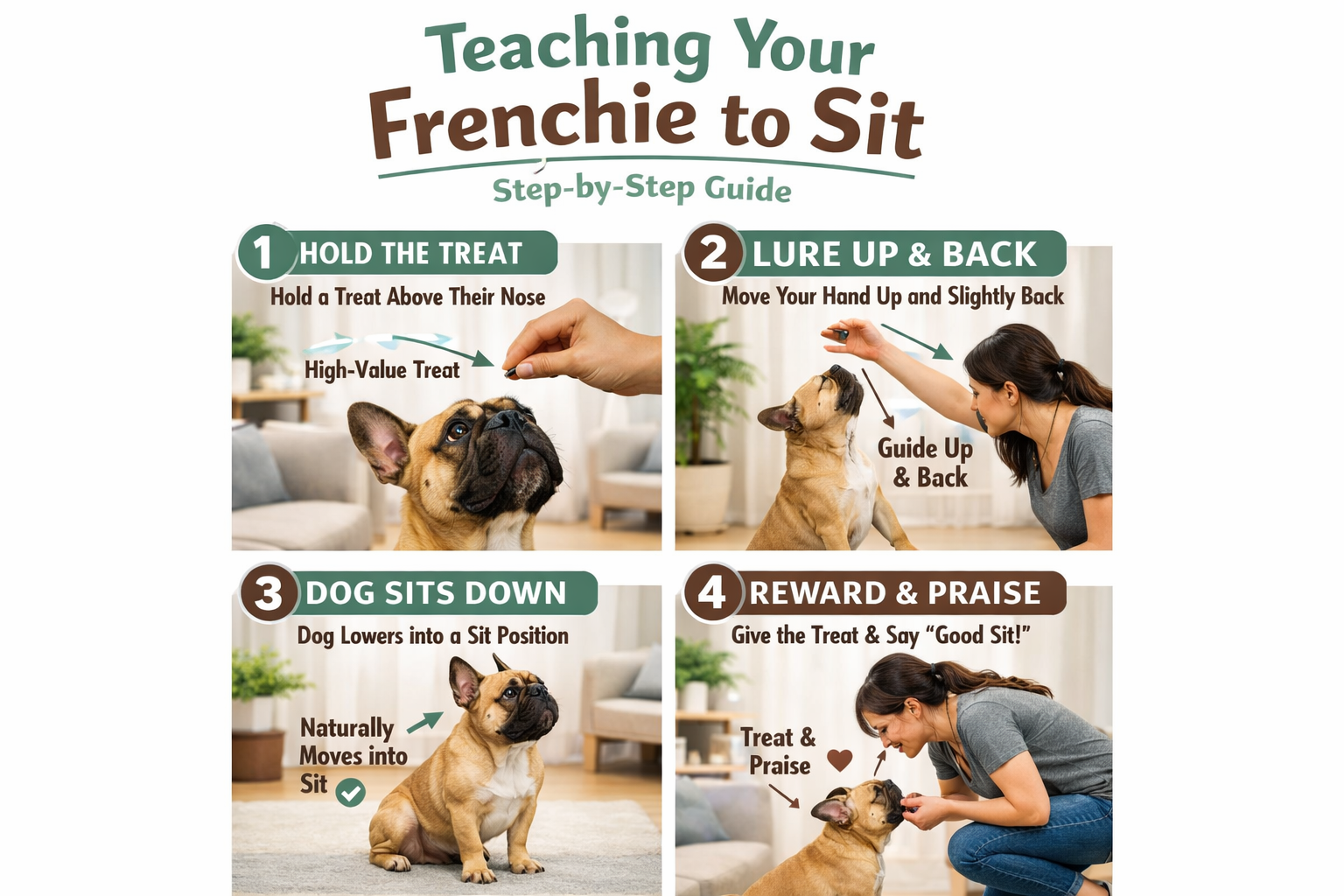
The luring method using high-value treats is the most effective way to teach French Bulldogs to sit. This technique involves holding a treat above your dog’s head and slowly moving it back over their skull, which naturally causes their bottom to lower to the ground.
French Bulldogs respond exceptionally well to food motivation and positive reinforcement. Unlike some breeds that might need more complex training approaches, Frenchies typically master the sit command quickly when you use their natural food drive to your advantage.
Why luring works so well for French Bulldogs:
- Takes advantage of their strong food motivation
- Creates a natural body movement without force
- Builds positive associations with training
- Works with their eager-to-please personality
How to Train French Bulldog to Sit Using the Luring Technique
Start with a high-value treat that your French Bulldog absolutely loves. Hold the treat close to their nose, then slowly lift it up and back over their head. As their nose follows the treat upward, their bottom will naturally lower to the ground.
Step-by-step luring process:
- Get your dog’s attention – Hold the treat right at nose level
- Move the treat slowly – Lift it 2-3 inches above their head
- Guide backward – Move the treat back over their skull
- Wait for the sit – Don’t rush; let gravity do the work
- Mark and reward – Say “yes” the moment their bottom touches down
- Give the treat immediately – Timing is crucial for learning
The key is patience. Some Frenchies will sit immediately, while others might take 10-15 seconds to figure out the movement. Avoid pushing their rear down or repeating commands during this learning phase[2].
For additional guidance on positive training methods, check out our complete guide to positive reinforcement training for French Bulldogs.
When Should You Add the Verbal “Sit” Command?
Add the verbal “sit” command only after your French Bulldog consistently sits when you use the luring motion. This typically happens after 5-10 successful luring repetitions over 1-2 training sessions.
Command timing sequence:
- Week 1: Pure luring without any verbal cues
- Week 2: Add “sit” as your dog begins to lower their bottom
- Week 3: Say “sit” before the luring motion
- Week 4: Practice “sit” with minimal or no luring
Important command guidelines:
- Use only the word “sit” – never “sit down”
- Say it once, then wait
- Keep your voice calm and encouraging
- Avoid repeating the command if they don’t respond immediately
This progression prevents confusion and helps your Frenchie clearly understand what the word “sit” means before you rely on it as the primary cue.
What Treats Work Best for Teaching French Bulldogs to Sit?
High-value, small, soft treats work best for sit training. Choose treats that are irresistible to your Frenchie but small enough that they won’t get full during training sessions.
Ideal treat characteristics:
- Size: Smaller than your thumbnail
- Texture: Soft and easy to chew quickly
- Flavor: Something your dog goes crazy for
- Convenience: Easy to break into tiny pieces
Top treat options for French Bulldogs:
- Small pieces of cooked chicken
- Freeze-dried liver
- High-quality training treats
- Small cubes of cheese (if tolerated)
- Tiny pieces of hot dog
For more specific recommendations, see our guide to the best treats for training French Bulldogs.
Training treat mistakes to avoid:
- Using treats that are too large
- Choosing crunchy treats that take time to eat
- Relying on regular kibble (usually not motivating enough)
- Using treats that cause digestive upset
How Often Should You Practice Sit Training Sessions?
Practice sit training 3-5 times daily in short 5-10 minute sessions. French Bulldogs learn better with frequent, brief training periods rather than long, intensive sessions that can lead to boredom or frustration.
Optimal training schedule:
- Morning: 5 minutes after breakfast
- Midday: 5 minutes before lunch
- Afternoon: 5 minutes during playtime
- Evening: 5 minutes before dinner
- Bedtime: 5 minutes as a calm activity
Session structure:
- Start with 3-5 successful sits
- Take a 30-second break
- Repeat for 2-3 rounds
- End on a positive note
Signs to end a session:
- Your dog seems distracted or disinterested
- They’re getting frustrated or confused
- You’ve achieved 5 perfect sits in a row
- 10 minutes have passed
FYI: Some links may be affiliate links, which means I may earn a small commission at no extra cost to you.
If you’re dealing with a reactive or easily distracted French Bulldog during training, consider exploring structured approaches that help build focus and calmness. A gentle, force-free training method can help reactive dogs become more focused and confident, making basic commands like “sit” much easier to teach.
Common Mistakes When Teaching French Bulldogs to Sit
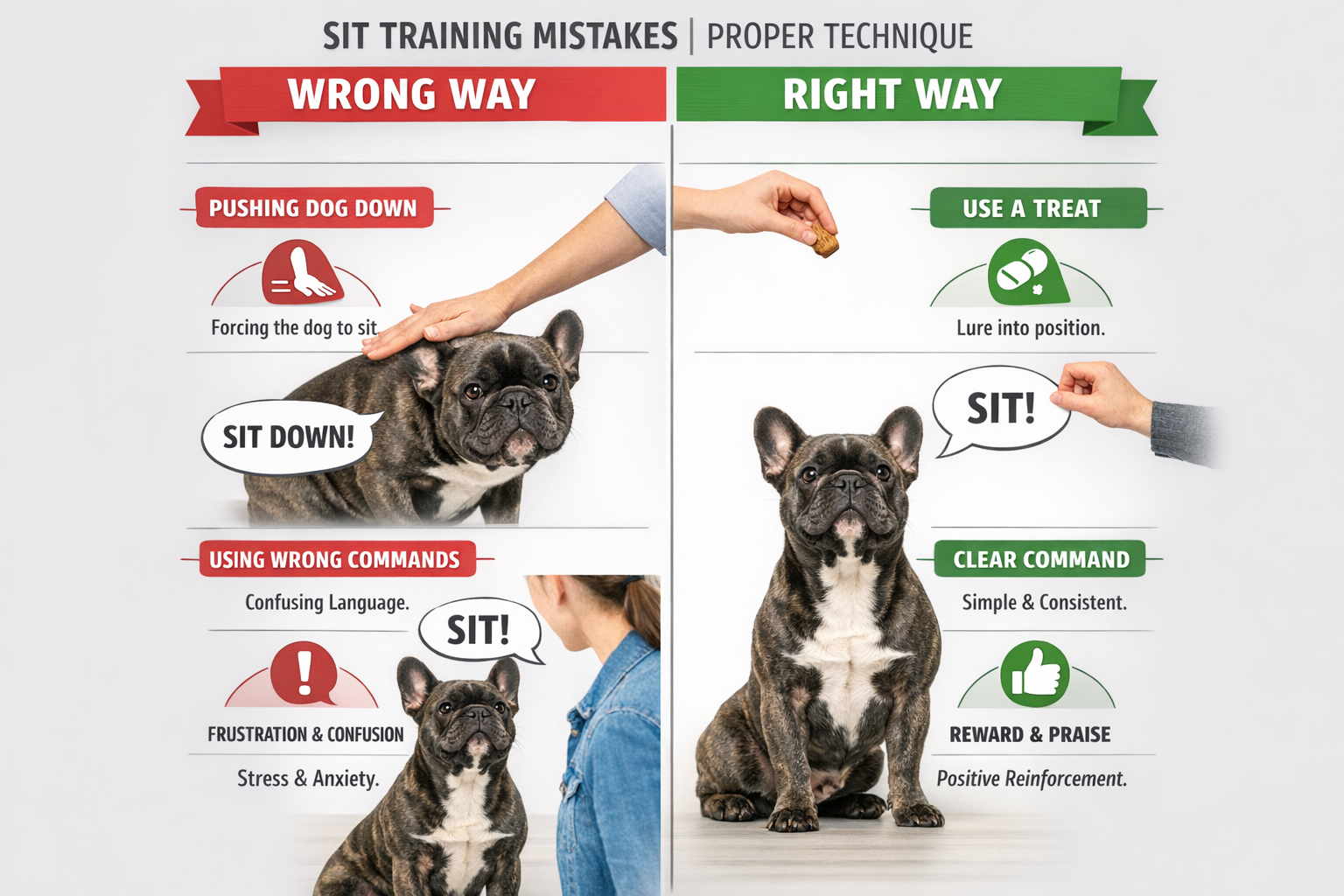
The most common mistake is saying “sit down” instead of just “sit.” This confuses dogs because “down” should be reserved for teaching the lying down position. Other frequent errors include pushing the dog’s rear down, repeating commands, and using treats that are too large.
Training mistakes that slow progress:
Verbal confusion:
- Saying “sit down” instead of “sit”
- Repeating the command multiple times
- Using different family members’ variations
Physical errors:
- Pushing your dog’s bottom down
- Holding treats too high or too low
- Moving the treat too quickly
Timing problems:
- Rewarding too late after the sit
- Not marking the exact moment of success
- Giving treats before the bottom touches ground
Session management:
- Training when your dog is too tired or too excited
- Making sessions too long
- Practicing in overly distracting environments
How to fix these mistakes:
- Stick to one simple command word
- Let your dog figure out the movement naturally
- Practice in quiet, familiar spaces first
- Keep treats at the right height (just above the head)
For comprehensive training guidance, explore our French Bulldog training tips for beginners.
How to Build Duration and Reliability in the Sit Command
Once your French Bulldog sits consistently on command, gradually increase how long they hold the position before getting their reward. Start with just one second of sitting, then slowly work up to 30 seconds or more.
Duration building steps:
Week 1-2: Immediate reward when bottom touches ground
Week 3: Count “one Mississippi” before rewarding
Week 4: Build to 3-5 seconds gradually
Week 5+: Work toward 15-30 seconds
Reliability training progression:
- Perfect the basics – 95% success rate in quiet spaces
- Add mild distractions – Practice with TV on or family nearby
- Change locations – Try different rooms, then outdoors
- Increase distance – Step back before giving the sit command
- Real-world practice – Use during daily activities
Building the “stay” component:
- Use an open palm “stop” hand signal
- Take one small step backward
- Return immediately and reward
- Gradually increase distance and duration
- Always return to your dog to release them
Signs your dog is ready for more challenge:
- Sits immediately on the first command
- Holds position for 5+ seconds consistently
- Performs reliably in multiple locations
- Shows enthusiasm for training sessions
Troubleshooting: What If Your French Bulldog Won’t Sit?
If your French Bulldog won’t sit using the luring method, the most likely causes are low-value treats, moving the treat too quickly, or practicing in an overly distracting environment. Try switching to higher-value rewards and slowing down your movements.
Common problems and solutions:
Problem: Dog jumps up instead of sitting
Solution: Hold treat closer to their head, move more slowly
Problem: Dog backs up instead of sitting
Solution: Practice against a wall to prevent backing up
Problem: Dog lies down instead of sitting
Solution: Don’t hold treat too high; keep it just above head level
Problem: Dog loses interest quickly
Solution: Use more exciting treats, shorter sessions
Problem: Inconsistent responses
Solution: Practice in the same quiet location until reliable
Advanced troubleshooting:
- Physical issues: Some Frenchies have hip or back problems that make sitting uncomfortable – consult your vet
- Attention problems: Work on basic focus exercises before sit training
- Fear or anxiety: Use even higher-value treats and more patience
- Age considerations: Puppies under 12 weeks may need more time to develop coordination
When to seek help:
- No progress after 2-3 weeks of consistent training
- Your dog shows signs of pain when attempting to sit
- Aggressive or fearful reactions to training
- You feel frustrated and need professional guidance
For more comprehensive puppy training strategies, check out our guide on how to train a French Bulldog puppy.
Helpful Resource for Structured Training

If you want something more structured to help with overall training success, there’s a gentle, force-free training approach that helps reactive dogs become calmer and more focused. This step-by-step method uses practical techniques trusted by many dog owners to create better focus and confidence, which makes teaching basic commands like “sit” much more effective.
This resource can be particularly helpful if your Frenchie gets easily distracted, anxious, or overstimulated during training sessions.
FAQ
Q: How long does it take to teach a French Bulldog to sit?
A: Most French Bulldogs learn to sit reliably within 3-7 days of consistent training. Some may master it in just 1-2 sessions, while others might need up to 2 weeks.
Q: Should I use a clicker when teaching my Frenchie to sit?
A: Clickers can be helpful but aren’t necessary. A simple “yes” or “good” works just as well as a marker. The key is consistent timing, not the specific sound you use.
Q: Can I teach an older French Bulldog to sit?
A: Absolutely. Adult and senior French Bulldogs can learn to sit using the same methods. Older dogs might take slightly longer but are often more focused than puppies.
Q: What if my French Bulldog already knows how to sit but won’t do it consistently?
A: Go back to basics with high-value treats and practice in low-distraction environments. Consistency issues usually mean the command isn’t fully reliable yet.
Q: Is it okay to gently push my dog’s bottom down to help them sit?
A: Light guidance is acceptable as a teaching aid, but avoid forceful pushing. The goal is to help them understand the movement, not to physically force compliance.
Q: How do I know if my French Bulldog has mastered the sit command?
A: Your dog has mastered “sit” when they respond to the verbal command alone 95% of the time in various locations and situations without needing treats every time.
Q: Should I practice sit training before or after meals?
A: Practice before meals when your dog is hungry and more motivated by food rewards. Avoid training immediately after large meals when they might feel sluggish.
Q: What’s the difference between “sit” and “sit-stay”?
A: “Sit” means get into the sitting position. “Sit-stay” means sit and remain in that position until released. Teach a reliable sit first before adding duration.
Q: Can I teach multiple family members to train my French Bulldog to sit?
A: Yes, but ensure everyone uses the same command word, timing, and reward system. Consistency across all family members speeds up learning.
Q: Why does my French Bulldog sit perfectly at home but not outside?
A: This is normal. Dogs need to generalize commands across different environments. Practice the sit command in gradually more distracting locations.
Q: How many treats should I give during each training session?
A: Use 10-15 small treats per 5-10 minute session. Adjust your dog’s meal portions slightly to account for training treats.
Q: What if my French Bulldog gets too excited during training?
A: Take breaks to let them calm down, use slightly less exciting treats, or train when they’re naturally calmer, like after a walk or play session.
Conclusion
Learning how to train French Bulldog to sit successfully comes down to using the right technique, timing, and treats. The luring method works exceptionally well for Frenchies because it takes advantage of their food motivation and eager-to-please personality. Remember to add the verbal command only after your dog understands the physical movement, keep sessions short but frequent, and always end on a positive note.
Your next steps:
- Gather supplies – Get high-value, small training treats your Frenchie loves
- Start with luring – Practice the treat-guided movement 5-10 times without verbal commands
- Add the word “sit” – Introduce the verbal cue once the movement is consistent
- Build reliability – Practice in different locations and with mild distractions
- Expand your training – Use the sit command as a foundation for other obedience skills
The sit command will become the building block for all future training, from teaching your French Bulldog not to jump to mastering leash training. With patience and consistency, you’ll have a well-mannered Frenchie who sits reliably on command, making daily life more enjoyable for both of you.
References
[1] 5 Wonderful French Bulldogs Commands – https://www.frenchie.shop/blogs/frenchie-shop-blog/5-wonderful-french-bulldogs-commands
[2] How To Train Your French Bulldog To Sit – https://nibbleypets.com/blogs/news/how-to-train-your-french-bulldog-to-sit
[3] Sit Training – https://www.dogstrust.org.uk/dog-advice/training/basics/sit-training
[4] How To Train French Bulldog – https://shop.bullymax.com/blogs/news/how-to-train-french-bulldog
[5] French Bulldog Puppy Training 101 Essential Tips – https://www.joiipetcare.com/blogs/advice/french-bulldog-puppy-training-101-essential-tips