
French Bulldog Clicker Training Tips: Master Positive Reinforcement for Your Frenchie
Last updated: February 21, 2026
Key Takeaways
• Clicker training uses precise timing to mark desired behaviors instantly, making it perfect for French Bulldogs who thrive on clear communication
• Always follow every click with a reward — breaking this promise undermines the entire training system
• Start with simple behaviors like “sit” before progressing to complex commands or addressing behavioral issues
• French Bulldogs typically learn the click-treat association within 1-2 days using short, frequent sessions
• Timing is everything — click the exact moment your Frenchie performs the desired behavior, then deliver the treat quickly
Quick Answer
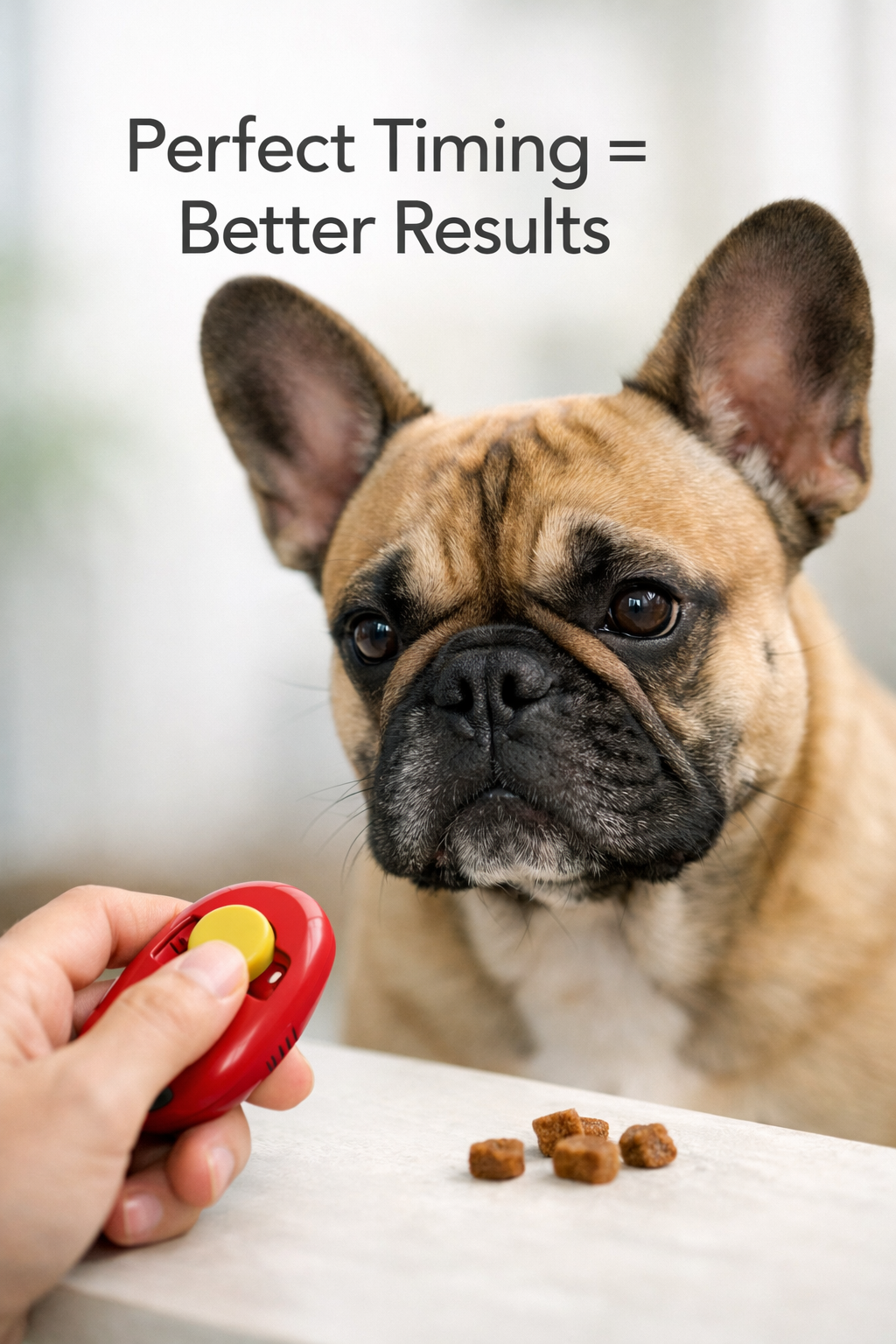
Clicker training works exceptionally well for French Bulldogs because it provides instant, precise feedback that matches their intelligent but sometimes stubborn nature. The key is building a strong click-treat association first, then using perfect timing to mark desired behaviors like sitting, staying, or walking calmly. Most Frenchies master basic clicker concepts within a few days when you use 5-10 minute sessions with high-value treats.
What Makes Clicker Training Perfect for French Bulldogs?
Clicker training is a positive reinforcement method that uses a distinctive clicking sound to mark the exact moment your French Bulldog performs a desired behavior, immediately followed by a reward. This approach works particularly well for Frenchies because it provides crystal-clear communication without the confusion that often comes with verbal cues.
French Bulldogs are intelligent dogs who want to please their owners, but they can also be selective listeners when they don’t understand what you’re asking. The clicker eliminates this confusion by creating a precise “yes, that’s exactly right!” moment.
Why French Bulldogs Excel with Clicker Training
Food motivation is typically high in French Bulldogs, making them ideal candidates for clicker training. Unlike some breeds that might prefer play or praise, most Frenchies will work enthusiastically for the right treats.
The method also suits their learning style. French Bulldogs process information quickly but need clear, consistent signals. The clicker provides that consistency — it sounds exactly the same every time, unlike human voices that can vary in tone or timing.
Choose clicker training if your Frenchie responds well to treats, you want to teach precise behaviors, or you’re dealing with a stubborn dog who ignores traditional verbal commands. Avoid this method if your dog is noise-sensitive or if you can’t commit to the timing requirements.
For comprehensive training approaches that complement clicker work, check out our French Bulldog Training Tips for Beginners.
Essential French Bulldog Clicker Training Tips for Getting Started
Begin by building the click-treat association before attempting any actual commands — this foundation determines your entire training success. Most French Bulldogs understand this connection within 1-2 days using multiple short sessions.
Building the Foundation
Start with these steps in a quiet room with minimal distractions:
- Hold treats and clicker ready — keep treats easily accessible in a pouch or pocket
- Click once, immediately give treat — no commands, no expectations, just click-treat
- Repeat 10-15 times per session — watch for your Frenchie to perk up at the click sound
- Practice 3-5 sessions daily — each session should last only 2-3 minutes
FYI: Some links may be affiliate links, which means I may earn a small commission at no extra cost to you.
Timing Your Clicks
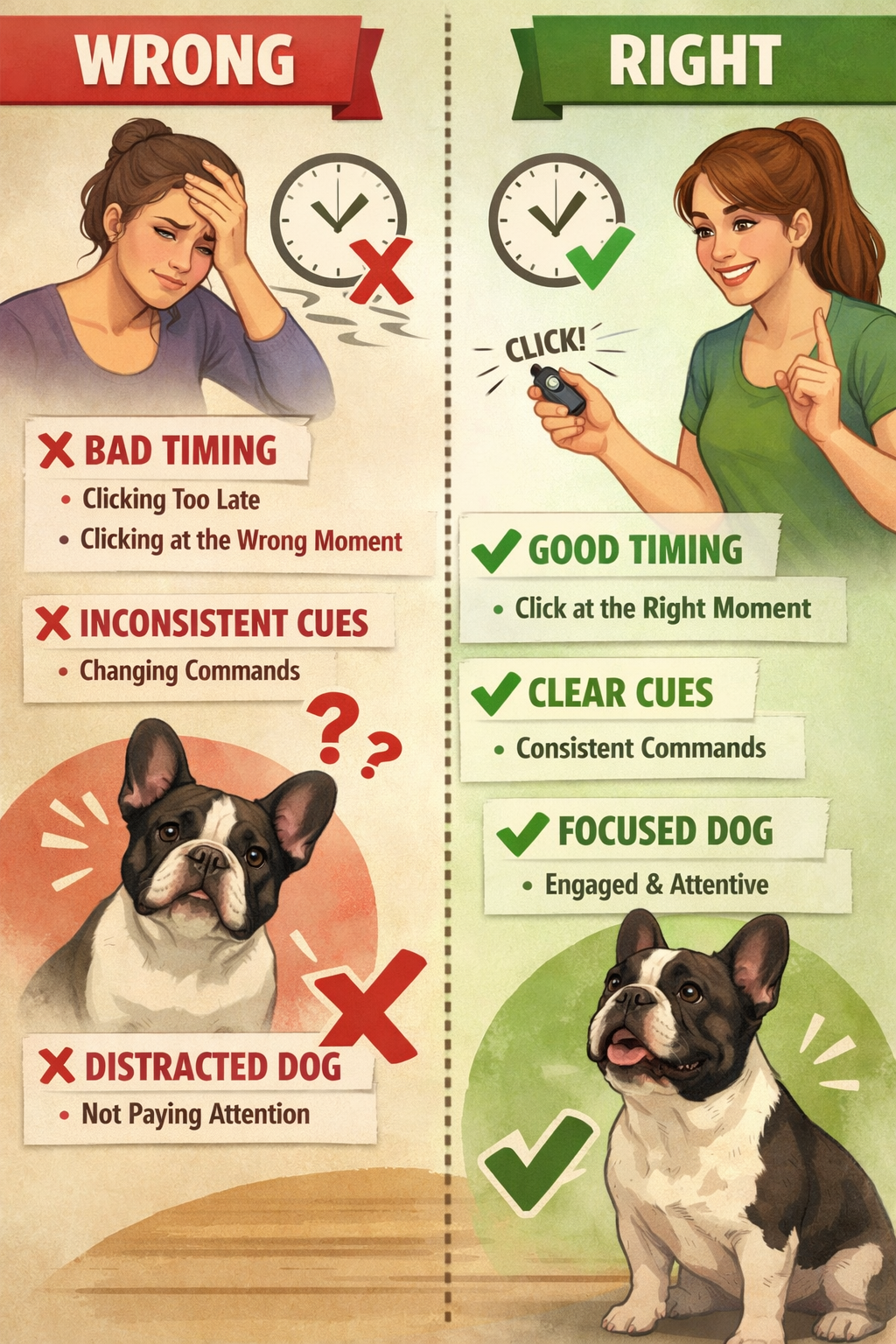
The clicker must capture the exact moment your French Bulldog performs the desired behavior — not before, not after. Late clicks confuse your dog about which action earned the reward.
Common timing mistakes include clicking when your dog is already standing up from a sit, or clicking while they’re still lowering into position. Practice your timing with simple behaviors first.
The treat must follow quickly after the click to build a strong association, though this interval can be gradually increased for advanced training[4]. Start with immediate delivery, then slowly work up to 2-3 second delays.
If you’re working on leash manners alongside clicker training, our French Bulldog Leash Training Tips provides complementary techniques.
Step-by-Step French Bulldog Clicker Training Tips for Basic Commands
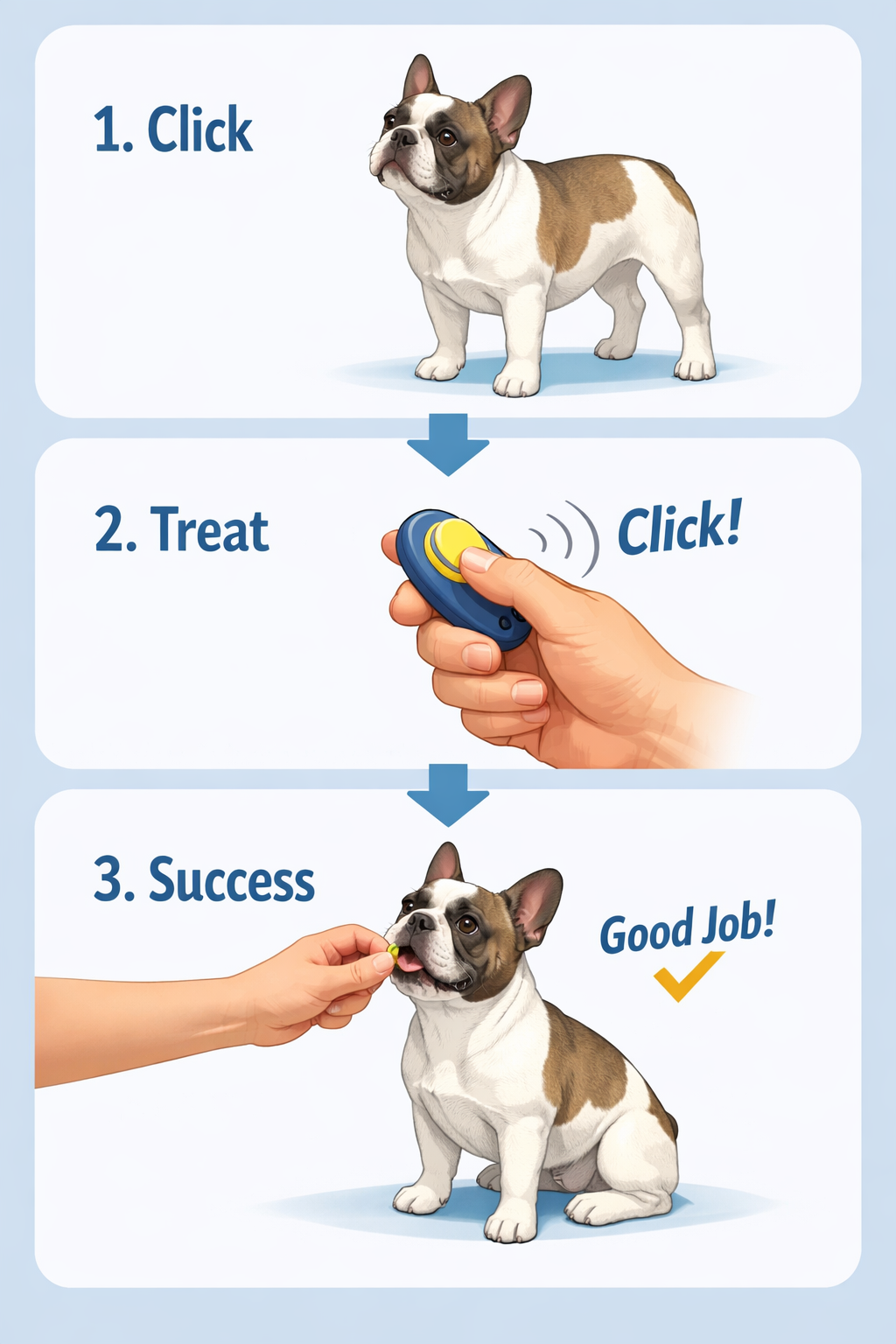
Start with “sit” as your foundation command because it’s natural for French Bulldogs and provides a clear success moment when their bottom touches the ground. Don’t introduce the verbal cue until your dog reliably performs the action.
Teaching “Sit” with the Clicker
Hold a treat close to your Frenchie’s nose, then slowly lift it over their head. As their head follows the treat, their bottom naturally lowers to the ground.
Click the instant their rear end touches the floor — this timing is crucial for clear communication. Immediately give the treat and offer brief praise.
Repeat 5-10 times per session without saying “sit.” Your goal is to get your dog offering the behavior freely before adding any verbal cue.
Adding the Verbal Cue
Only introduce “sit” after your French Bulldog consistently lowers into position when they see the treat motion. This typically takes 2-3 training sessions.
Say “sit” just before your dog begins lowering — you want them to hear the word as they’re starting the action, not after they’re already down.
Gradually phase out the treat lure by making smaller hand motions, but continue clicking and rewarding every successful sit.
Progressing to Other Commands
“Stay” builds naturally from a solid sit command. Click and treat for maintaining the sitting position for gradually longer periods — start with 1-2 seconds, then build to 10+ seconds.
“Come” requires starting in a small, enclosed space where your Frenchie can’t make mistakes. Click when they move toward you, even just a step.
For more detailed command training, see our guide on French Bulldog Commands Every Owner Should Teach.
Advanced French Bulldog Clicker Training Tips for Problem Behaviors
Clicker training excels at replacing unwanted behaviors with positive alternatives rather than simply saying “no” to everything your French Bulldog does wrong. This approach works especially well for common Frenchie issues like jumping, pulling, or attention-seeking barking.
Addressing Jumping
Click and treat when your French Bulldog has all four paws on the ground, especially when greeting people. This teaches them that calm greetings earn rewards while jumping gets ignored.
Set up practice scenarios with family members entering the house. The moment your Frenchie chooses to sit or stand calmly instead of jumping, click and reward immediately.
If your dog is already jumping, turn away and ignore them completely. The instant they drop down, click and treat. This creates a clear contrast between ignored jumping and rewarded calm behavior.
Managing Leash Pulling
Click when the leash is loose, not when your dog returns to your side after pulling. This distinction teaches your Frenchie that maintaining a loose leash earns rewards, not just correcting their position.
Start indoors or in your yard before progressing to sidewalk walks. French Bulldogs need to understand the concept in low-distraction environments first.
Use high-value treats for outdoor training since competing distractions require stronger motivation. Regular kibble might work indoors but won’t compete with interesting smells on walks.
If your Frenchie struggles with reactivity during walks, this gentle, structured training solution offers force-free techniques specifically designed to help reactive dogs become calmer and more focused on walks — from reducing barking and lunging to building better leash manners and confidence in distracting environments.
For additional leash training strategies, check out our Leash Pulling Solution for French Bulldogs.
Reducing Attention-Seeking Behaviors
French Bulldogs are masters at training their humans through persistent barking, pawing, or nudging. Clicker training flips this dynamic by rewarding quiet, calm behavior instead.
Click during moments of natural calm — when your dog is lying down quietly, sitting without being asked, or simply existing peacefully near you.
Ignore attention-seeking completely while actively rewarding the opposite behaviors. This creates a clear choice: demand attention and get nothing, or be calm and earn rewards.
Common Mistakes in French Bulldog Clicker Training Tips
The biggest error is clicking without immediately following through with a reward — this breaks the promise that makes clicker training work[2][4]. Even if you’re distracted or fumble the treat, you must deliver something rewarding after every click.
Timing and Consistency Errors
Clicking too late is more common than clicking too early. French Bulldogs move quickly, and by the time you process what they did and reach for the clicker, the moment has often passed.
Practice clicking for everyday behaviors like your dog naturally sitting, lying down, or looking at you. This builds your timing skills without the pressure of formal training.
Using the clicker as a recall tool defeats its purpose. The click marks a completed behavior, not a request for attention or a come-here signal.
Reward and Motivation Issues
Using boring treats undermines the entire system. French Bulldogs need rewards that are genuinely exciting — think small pieces of chicken, cheese, or commercial training treats, not regular kibble.
Sessions that run too long lead to frustrated, distracted dogs. Keep training to 5-10 minutes maximum, especially for French Bulldogs who can overheat easily.
Training when your dog isn’t motivated wastes everyone’s time. If your Frenchie just ate dinner or seems tired, wait for a better moment.
Environmental and Progression Mistakes
Starting in distracting environments sets your dog up to fail. Master behaviors in quiet spaces before progressing to challenging settings.
Skipping the foundation by trying to teach complex behaviors before your dog understands the clicker system creates confusion and frustration.
Expecting too much too quickly is particularly common with intelligent breeds like French Bulldogs. Just because your dog is smart doesn’t mean they’ll master everything in one session.
For troubleshooting stubborn behaviors, our Training a Stubborn French Bulldog guide offers additional strategies.
When to Phase Out the Clicker
The clicker can eventually be replaced with verbal praise or other rewards once behaviors are well-established, but this transition should happen gradually. Most French Bulldogs need 2-4 weeks of consistent clicker training before behaviors become reliable enough to start fading the tool.
Signs Your Dog Is Ready
Your French Bulldog offers behaviors eagerly without needing lures or prompts. They understand what you want and perform commands quickly and accurately.
Behaviors happen reliably in various environments — not just in your quiet training room but also in the yard, on walks, or with distractions present.
Your dog shows enthusiasm for training sessions and anticipates the clicker work. Clicker-trained dogs develop into confident, eager learners who look forward to training time.
Making the Transition
Replace some clicks with verbal praise while maintaining the same reward schedule. Say “good” or “yes” instead of clicking, but still give treats immediately.
Gradually reduce treat frequency while maintaining verbal praise. Move from rewarding every success to rewarding every other success, then every third, and so on.
Keep the clicker available for teaching new behaviors or fine-tuning existing ones. Many trainers continue using clickers for precision work even after basic commands are solid.
The clicker remains useful for complex behaviors that require exact timing or for addressing new problem behaviors that emerge over time.
Helpful Resource for Reactive French Bulldogs
If your Frenchie struggles with reactivity, barking, or lunging during walks, you might find this step-by-step webinar helpful. It focuses on creating calmer, more focused walks using force-free techniques that complement clicker training beautifully. Not required, but useful for dogs who need extra support with impulse control and confidence building.
Frequently Asked Questions
How long does it take French Bulldogs to learn clicker training?
Most French Bulldogs understand the click-treat association within 1-2 days using 3-5 short sessions daily. Basic commands like “sit” typically take 3-5 days to become reliable.
Can I use a clicker with a noise-sensitive French Bulldog?
Yes, try a softer clicker, muffle the sound with tape, or use a verbal marker like “yes” instead. The key is consistency, not the specific sound.
What treats work best for French Bulldog clicker training?
Small, soft, high-value treats that can be eaten quickly work best. Think tiny pieces of chicken, cheese, or commercial training treats rather than crunchy kibble.
Should I click for partial behaviors or only perfect ones?
Start by clicking partial behaviors to build momentum, then gradually require more precision. For example, click when your dog starts to sit, then only when they complete the action.
Can I use clicker training to stop my French Bulldog from barking?
Yes, but focus on clicking quiet moments rather than trying to click during barking. Reward the absence of barking and alternative calm behaviors.
How many times should I click during one training session?
Keep sessions short with 10-20 clicks maximum. French Bulldogs learn better from multiple brief sessions than long, exhausting ones.
What if my French Bulldog ignores the clicker?
Ensure you’re using high-value treats, training when your dog is motivated, and building the click-treat association properly before attempting commands.
Can older French Bulldogs learn clicker training?
Absolutely. Adult and senior French Bulldogs often learn faster than puppies because they have better attention spans and impulse control.
Should I use the clicker for housebreaking?
Clickers work well for marking successful potty breaks outside, but combine this with other housebreaking strategies for best results.
How do I know if I’m clicking at the right time?
Practice with simple, obvious behaviors first. If your dog seems confused or progress stalls, you’re likely clicking too early or too late.
Can multiple family members use the clicker with the same dog?
Yes, but everyone needs to use the same timing and reward system. Consistency across handlers is crucial for success.
What’s the difference between clicker training and regular treat training?
The clicker provides precise timing and a consistent marker that doesn’t vary like human voices do. This clarity helps dogs learn faster and more accurately.
Key Takeaways
• Build the click-treat association first — spend 1-2 days on this foundation before attempting any commands
• Perfect your timing — click the exact moment your French Bulldog performs the desired behavior, not before or after
• Keep sessions short and frequent — 5-10 minutes multiple times daily works better than long training marathons
• Use high-value treats that genuinely motivate your Frenchie, not boring kibble or low-interest rewards
• Start in quiet environments and gradually progress to more distracting settings as behaviors become reliable
• Focus on rewarding good choices rather than punishing mistakes — clicker training builds confidence and enthusiasm
• Be consistent with the click-treat promise — never click without following through with a reward
• Phase out the clicker gradually once behaviors are solid, but keep it available for teaching new skills
• Combine with other training methods for comprehensive behavior modification and skill building
• Practice your own timing skills with everyday behaviors before tackling formal training sessions
Conclusion
Clicker training offers French Bulldog owners a powerful, positive method for building clear communication and strong behaviors. The precision of the click, combined with your Frenchie’s natural food motivation and intelligence, creates an ideal learning environment that builds confidence rather than confusion.
Start with the basics — establish that click-treat association, master your timing, and begin with simple commands like “sit.” As your skills and your dog’s understanding develop, you can tackle more complex behaviors and even address problem issues like jumping or pulling.
Remember that consistency and patience matter more than perfection. Your French Bulldog will learn from every interaction, so focus on setting both of you up for success with short sessions, high-value rewards, and realistic expectations.
The investment in clicker training pays dividends throughout your dog’s life. You’ll have a reliable communication system for teaching new behaviors, addressing challenges, and maintaining the strong bond that makes French Bulldogs such wonderful companions.
Ready to get started? Grab a clicker, some irresistible treats, and begin building that foundation today. Your Frenchie is waiting to show you just how smart and eager to please they really are.
References
[1] Dog Clicker Training – https://www.kinship.com/uk/dog-behaviour/dog-clicker-training
[2] Training Methods Clicker Training – https://positively.com/dog-training/article/training-methods-clicker-training
[3] How To Train French Bulldog – https://shop.bullymax.com/blogs/news/how-to-train-french-bulldog
[4] Watch – https://www.youtube.com/watch?v=ObUi8oTdybQ
[5] Clicker Training For Dogs – https://www.pets4homes.co.uk/pet-advice/clicker-training-for-dogs.html